



About the project
About the project


We worked with Stepney Community Trust and individuals of South Asian heritage to co-research and co-curate the monuments at St Paul’s Cathedral related to the East India Company.
We took a community-centred approach for addressing the East India Company’s history and legacy, engaging in a rigorous process of collaborative research, interpretation, and curation. Some of our activities included:
- two introductory sessions
- four expert-led historical seminars
- East India Docks walking tour
- visit to St Paul’s library and archives
- support with individual historical research
- two collaborative writing workshops
Project aim
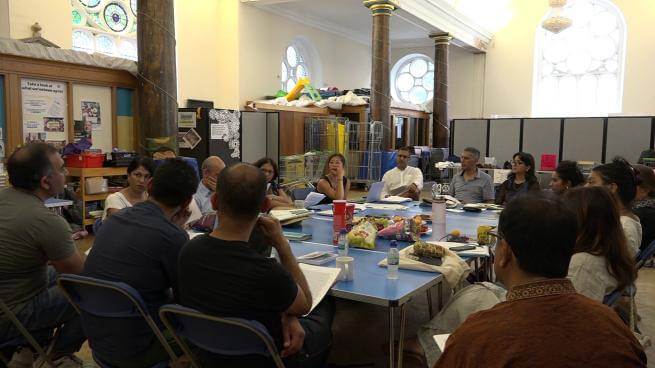
The project formed partnership between the Cathedral and Stepney Community Trust by:
widening engagement and participation activities with Stepney Community Trust: We hosted a visit to the Cathedral for English learners and facilitated a discussion about South Asian history, the British empire, migration and belonging
promoting Stepney Community Trust’s charitable mandate through a grant to support class-based activities and community gatherings (sewing, meditation, and walk&talk sessions) for disadvantaged people living in the London Borough of Tower Hamlets
harnessing the partnership to strengthen the Cathedral’s Visitor Experience services by improving on-site and online information about our collections, and by updating the Cathedral’s provision and training for equality, diversity and inclusion.
About Stepney Community Trust
Established in 1982, initially under the name of St Mary’s Centre, Stepney Community Trust is a grassroots charity with a long history of community action, providing welfare advice, housing support, and advocacy services especially to the Bangladeshi community in East London. They have engaged in several heritage projects funded by the Heritage Lottery Fund about the East India Company. The ‘East India Company at St Paul’s’ trail has been created in collaboration with a group of community authors and researchers, who have produced the interpretation texts for the trail based on rigorous research into the latest scholarship and the context of their own experiences.
Acknowledgements
Authors (Stepney Community Trust)
Ricky Ahluwalia, Naajia Ahmed, Muhammad Ahmedullah, Niaz Alam, Alum Bati, Taryn Khanam, Abdul Sabur Kidwai, Monna Matharu, Fawzia Mahmood, Sanchita Mukherjee, Mian Obaid Shah, Asif Shakoor, Amrita Shodhan; (United Society Partners in the Gospel) Peniel Rajkumar; (Other) Renie Chow Choy, Gopal Gurung
Collaborating Partner
Stepney Community Trust
Collaborating Partner Project Coordinator
Dr Muhammad Ahmedullah
Collections Community Engagement Project Manager
Dr Renie Chow Choy
Historical Consultant
Prof Nandini Chatterjee, Professor of South Asian History, University of Exeter
Project Advisor
Dr Georgie Wemyss, Senior Lecturer and Co-Director, Centre for Research on Migration, Refugees and Belonging (CMRB), University of East London
Additional Seminar Speakers
Prof Arthur Burns, Dr Greg Sullivan, Prof Amina Yaqin
Additional thanks to:
Dianna Djokey, Kayte McSweeney, Sian Harrington, Dee Dyas, Georgina Graham
Graphic Designer
Sonal Agarwal
Cartographer
Dr Gabriel Moss
We are grateful to Sr Christine Frost and Nizam Uddin from Neighbours in Poplar for use of St Matthias Old Church, built by the East India Company and completed in 1654 to serve as a chapel close to the dockyards and almshouse for disabled seamen.
This project was made possible by the Esmée Fairbairn Collections Fund -- delivered by the Museums Association.
This community engagement initiative builds upon ‘Pantheons: Sculpture at St Paul's Cathedral, c.1796-1916’, an academic research project hosted at the University of York’s Department of History of Art. We are grateful to Jason Edwards, Greg Sullivan, and Marjorie Coughlan for the art catalogue entries providing information on the monuments. For more information, visit: pantheons-st-pauls.york.ac.uk